
Hangbo Alloy Group
Shanghai · Est. 2012
Forged nickel alloy flanges for corrosive and high-temperature piping. Welding neck, slip-on, socket weld, lap joint, threaded and blind types to ASME B16.5 and B16.47.
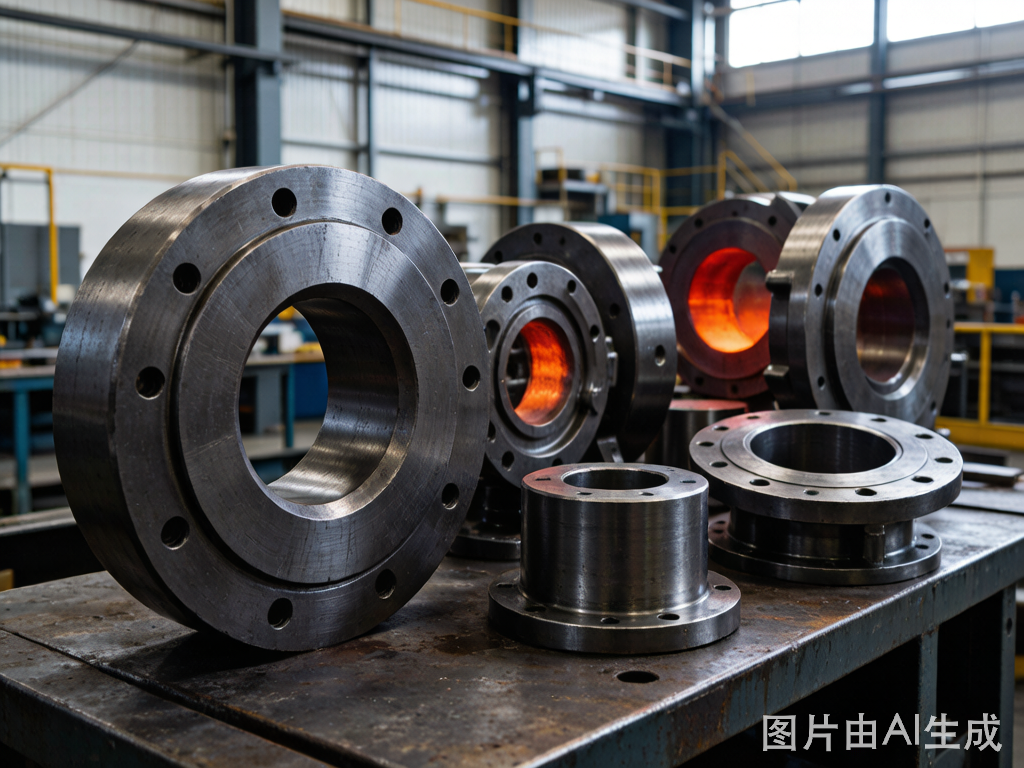
Hangbo Alloy Group manufactures forged nickel alloy flanges on open-die and closed-die presses from billet produced by vacuum induction melting (VIM) and electroslag remelting (ESR). Forging refines the grain structure and closes centre porosity, giving flange bodies with uniform through-thickness properties and no discontinuity at the hub-to-rim transition — the location where cast or plate-cut flanges most often fail.
Every flange is supplied solution-annealed, pickled and stamped to the applicable standard, with a heat number that traces back to the melt record. Dimensional inspection covers bore, bolt circle, hub diameter, flange thickness and facing finish; positive material identification (PMI) is performed on 100 % of pieces on request.
| Type | Standard | Typical use |
|---|---|---|
| Welding Neck (WN) | ASME B16.5 | High pressure, cyclic thermal duty |
| Slip-On (SO) | ASME B16.5 | Low pressure, easy alignment |
| Socket Weld (SW) | ASME B16.5 | Small bore, NPS 1/2 - 3 |
| Lap Joint (LJ) | ASME B16.5 | With stub end, frequent dismantling |
| Threaded (TH) | ASME B16.5 | Non-welded, low pressure |
| Blind (BL) | ASME B16.5 | Line termination, pressure test |
Pressure classes 150, 300, 400, 600, 900, 1500 and 2500 are available in sizes from NPS 1/2 to NPS 24 to B16.5, and NPS 26 to NPS 60 to B16.47 Series A and B. Facing options include raised face (RF), flat face (FF), ring-type joint (RTJ) and tongue-and-groove.
Material is supplied to ASTM B564 / ASME SB564 for nickel alloy forgings, with complementary certification to NACE MR0175 / ISO 15156 where the flange enters sour service. See our alloy knowledge centre for grade-by-grade corrosion data.
Our in-house melting, forging and testing capability is described on the facilities page, and our quality approvals are listed under certifications.
They are technically identical specifications. ASTM B564 is the material specification for nickel alloy forgings; ASME SB564 is the same specification adopted into the ASME Boiler and Pressure Vessel Code. A flange ordered to SB564 is accepted for code-stamped vessels and piping.
Yes. For sour service we control chemistry, heat treatment and hardness so the finished forging meets NACE MR0175 / ISO 15156 limits, and we certify hardness survey results with the shipment.
Yes. Beyond the ASME B16.5 and B16.47 ranges we forge to customer drawings, including large-diameter ring flanges, tube-sheet forgings and integrally reinforced nozzles. Send the drawing and our engineers will confirm feasibility and lead time.
Send us your grade, diameter, length, quantity, and any special requirements. Our team responds within 10 minutes during business hours.