
⚡ Quick Specs: Inconel 751
What Is Inconel 751?
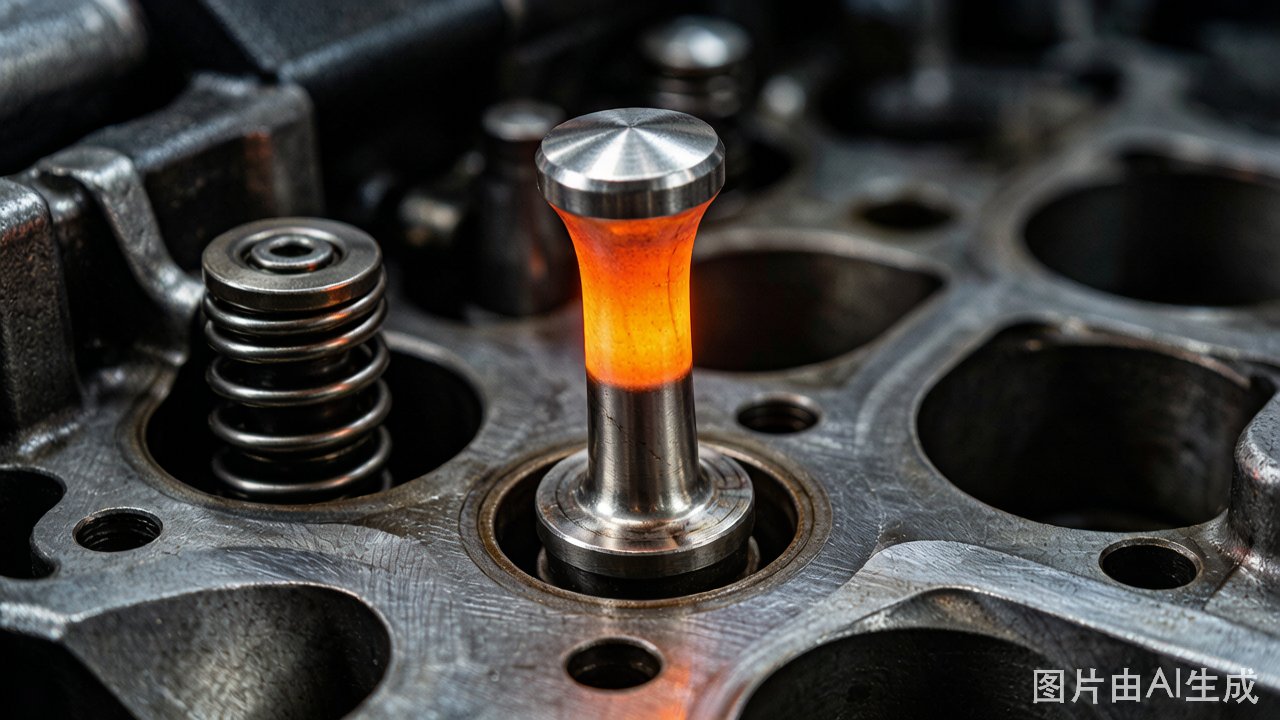
Inconel 751 (UNS N07751 / W.Nr. 2.4694) is a precipitation-hardenable nickel-chromium alloy engineered specifically for internal combustion engine exhaust valves. Its strength comes from γ′ (Ni₃(Al,Ti)) precipitation hardening, providing exceptional hot strength and creep resistance up to 870°C. The alloy offers outstanding resistance to lead oxide corrosion, sulfur compounds, and combustion gas attack — making it the material of choice for diesel and high-performance gasoline engines worldwide. As a trusted Inconel 751 supplier, Hangbo Alloy Group provides this critical valve alloy with full traceability.
Chemical Composition
The nominal chemical composition of Inconel 751 is shown below. All values are in weight percent (wt%) unless otherwise noted.
| Element | Content (wt%) |
|---|---|
| Ni+Co | ≥ 70.0 |
| Cr | 14.0–17.0 |
| Fe | 5.0–9.0 |
| Nb+Ta | 0.7–1.2 |
| Al | 0.9–1.5 |
| Ti | 2.0–2.6 |
| Mn | ≤ 1.0 |
| Si | ≤ 0.5 |
| Cu | ≤ 0.5 |
| C | ≤ 0.10 |
| P | ≤ 0.02 |
| S | ≤ 0.01 |
Physical Properties
| Property | Value |
|---|---|
| Density | 8.22 g/cm³ (0.297 lb/in³) |
| Melting Range | 1390–1430 °C (2534–2606 °F) |
| Specific Heat | ~460 J/kg·K (at 20°C) |
| Thermal Conductivity | ~12.0 W/m·K (at 20°C) |
| Electrical Resistivity | ~1.25 µΩ·m (at 20°C) |
| Young's Modulus | ~214 GPa |
| Thermal Expansion (20–100°C) | ~13.0 µm/m·°C |
Mechanical Properties (Room Temperature)
| Property | Value |
|---|---|
| Tensile Strength (aged) | ≥ 1310 MPa (190 ksi) |
| Yield Strength (0.2%, aged) | ≥ 965 MPa (140 ksi) |
| Elongation (aged) | ≥ 22% |
| Hardness (aged) | ≤ 35 HRC (before aging: ~32 HRC) |
| Stress-Rupture 700°C / 100h | ≥ 450 MPa typical |
| Condition | Solution Annealed + Aged |
High-Temperature Corrosion & Oxidation Resistance
Inconel 751 delivers exceptional resistance to the aggressive combustion gas environments found in modern internal combustion engines. Its carefully balanced Cr-Al-Ti composition ensures reliable performance under thermal cycling, oxidation, and chemical attack from fuel combustion products.
- Outstanding resistance to lead oxide (PbO) corrosion — critical for engines burning leaded or contaminated fuels. In standardized PbO screening tests at 913°C, Inconel 751 exhibited an average corrosion rate of approximately 4.31 g/dm²/h
- Excellent oxidation resistance up to 870°C (1600°F) in air and combustion gas environments
- Good resistance to sulfur-containing exhaust gases including SO₂ and H₂S at elevated temperatures
- Resistant to halogen attack (bromine, chlorine compounds) that may be present in combustion products
- Good carburization resistance in carbon-rich combustion atmospheres
- Retains protective oxide scale integrity under severe thermal cycling conditions
Applications
Inconel 751 was specifically designed for the extreme demands of internal combustion engine exhaust valves. Operating at temperatures up to 870°C in aggressive combustion gas environments containing lead oxides, sulfur compounds, and other corrosive species, the alloy relies on γ′ (Ni₃(Al,Ti)) precipitation hardening to maintain strength where conventional austenitic valve steels would fail.
| Application Area | Typical Components & Notes |
|---|---|
| Diesel Engine Exhaust Valves | The primary application — marine diesel, locomotive, power generation, and heavy-duty truck engines |
| Gasoline Engine Exhaust Valves | High-performance and turbocharged gasoline engines with elevated exhaust gas temperatures |
| Turbocharger Components | Turbine wheels, shafts, and housings in high-temperature exhaust gas paths |
| Gas Turbine Components | Secondary turbine parts requiring moderate creep resistance at 700–800°C |
| Industrial Furnace Fixtures | High-temperature trays, baskets, and support structures |
| Heat Treatment Equipment | Radiant tubes, muffles, and retorts for thermal processing |
| Petrochemical Processing | High-temperature reactor internals and heat exchanger components |
Available Product Forms
| Product Form | Typical Dimensions |
|---|---|
| Round Bars (AMS 5589) | φ6–φ200 mm, Hot-rolled, Forged, Centerless ground |
| Wire (AMS 5590) | φ0.3–φ12 mm, Annealed, Spring temper |
| Forgings | Valve blanks, Discs, Rings per customer specification |
| Plates & Sheets | Limited availability — consult for specific sizes |
Related Standards & Specifications
| Standard | Product Scope |
|---|---|
| AMS 5589 | Bars, Forgings, and Rings — Solution and Precipitation Heat Treated |
| AMS 5590 | Corrosion and Heat Resistant Steel Welding Wire |
| ASTM B637 | Precipitation-Hardening Nickel Alloy Bars, Forgings, and Forging Stock |
| DIN / EN W.Nr. | 2.4694 |
Frequently Asked Questions (FAQ)
1. What is Inconel 751 alloy?
Inconel 751 (UNS N07751 / W.Nr. 2.4694) is a precipitation-hardenable nickel-chromium alloy designed primarily for internal combustion engine exhaust valves. It achieves high strength through γ′ (Ni₃(Al,Ti)) precipitation hardening and maintains excellent hot strength, oxidation resistance, and lead oxide corrosion resistance up to 870°C.
2. What is the chemical composition of Inconel 751?
Inconel 751 nominal composition: Ni+Co ≥70%, Cr 14.0–17.0%, Fe 5.0–9.0%, Ti 2.0–2.6%, Al 0.9–1.5%, Nb+Ta 0.7–1.2%, Mn ≤1.0%, Si ≤0.5%, Cu ≤0.5%, C ≤0.10%, P ≤0.02%, S ≤0.01%. The combination of Al and Ti forms the γ′ strengthening phase, while Nb provides additional solid solution strengthening.
3. What is the density and melting point of Inconel 751?
Inconel 751 has a density of 8.22 g/cm³ (0.297 lb/in³) and a melting range of 1390–1430 °C (2534–2606 °F). Its density is comparable to other nickel-based superalloys like Inconel X-750 and Inconel 718.
4. What are the mechanical properties of Inconel 751?
In the fully heat-treated (solution annealed + aged) condition, typical room-temperature properties are: tensile strength ≥1310 MPa (190 ksi), yield strength ≥965 MPa (140 ksi), elongation ≥22%, hardness ~34 HRC. At 700°C, stress-rupture strength for 100-hour life is typically ≥450 MPa. The alloy maintains useful strength up to 870°C.
5. How is Inconel 751 heat treated?
The standard heat treatment for Inconel 751 is: (1) Solution anneal at 1100–1150°C (2010–2100°F) for 1–2 hours, followed by rapid air or water cooling; (2) Precipitation age at 730–760°C (1350–1400°F) for 8–16 hours, followed by air cooling. Some specifications may include a two-step aging treatment with an intermediate hold at 840°C. This treatment precipitates the γ′ strengthening phase responsible for high-temperature strength.
6. How does Inconel 751 compare to Inconel X-750?
Inconel 751 and Inconel X-750 are closely related. Inconel 751 was developed as a valve-specific variant of X-750 with modified titanium and aluminum levels optimized for exhaust valve applications. The key differences: 751 has higher Ti (2.0–2.6% vs 2.25–2.75% in X-750), lower Al (0.9–1.5% vs 0.40–1.0% in X-750), and slightly different Nb+Ta range. These adjustments provide 751 with superior lead oxide corrosion resistance and optimized high-temperature strength profile for valve service.
7. What is the maximum service temperature of Inconel 751?
Inconel 751 is suitable for continuous service up to approximately 870°C (1600°F). Above this temperature, the γ′ strengthening phase begins to coarsen and dissolve, reducing creep strength. For short-term exposure, the alloy can withstand temperatures up to 950°C without catastrophic degradation. For sustained service above 870°C, higher-temperature alloys like Nimonic 90 or Nimonic 105 may be appropriate.
8. Can Inconel 751 be welded?
Inconel 751 has limited weldability. The precipitation-hardening elements (Al and Ti) can cause strain-age cracking in the heat-affected zone (HAZ) during welding and subsequent heat treatment. If welded fabrication is required, the alloy should be welded in the solution-annealed condition using matching filler wire (AMS 5590), followed by a full solution anneal and age. For valve applications, Inconel 751 is typically used in the form of forged valve blanks rather than welded fabrications.
9. What are typical applications of Inconel 751?
The primary application is exhaust valves for diesel and gasoline internal combustion engines — including marine diesel, locomotive, heavy-duty truck, power generation, and high-performance automotive engines. Secondary applications include turbocharger components, gas turbine parts, furnace fixtures, and heat treatment equipment operating at 700–870°C.
10. What is the price and lead time for Inconel 751?
Inconel 751 is a premium exhaust valve alloy. Typical pricing: bars $35–55/kg, valve blanks $50–80/kg, depending on size and quantity. Lead times: 6–10 weeks for standard bar sizes, 10–14 weeks for custom-forged valve blanks. MOQ: 100–200 kg for bars, 50–100 pieces for standard valve blanks. Contact hangbo@nickel-alloy.com for current quotes.
11. Is Inconel 751 resistant to leaded fuel corrosion?
Yes, Inconel 751 was specifically developed with enhanced resistance to lead oxide (PbO) corrosion from leaded and contaminated fuels. In standardized testing at 913°C (1675°F), the alloy demonstrates an average PbO corrosion rate of approximately 4.31 g/dm²/h, which is significantly better than many competing valve alloys. This resistance, combined with excellent hot strength, makes it the material of choice for exhaust valves in applications where fuel quality may vary.
12. What are the available product forms for Inconel 751?
Inconel 751 is primarily available as bars (φ6–φ200 mm, AMS 5589), wire (φ0.3–φ12 mm, AMS 5590), and custom forgings including valve blanks, discs, and rings. Plates, sheets, and tubes have limited availability and should be confirmed with suppliers. Hangbo Alloy Group maintains stock of common bar sizes for rapid delivery.
Need Inconel 751 for Your Project?
Hangbo Alloy Group is a trusted global supplier of Inconel 751 in bars, plates, and custom forms. We provide competitive pricing, full material traceability, and EN 10204 3.1 mill test certificates with every order.