
Hangbo Alloy Group
Shanghai · Est. 2012
AMS 5950 — 4th-generation nickel-based superalloy developed by ATI for next-generation high-pressure turbine discs, offering ~30°C higher temperature capability than Inconel 718 with excellent fatigue strength and processability.
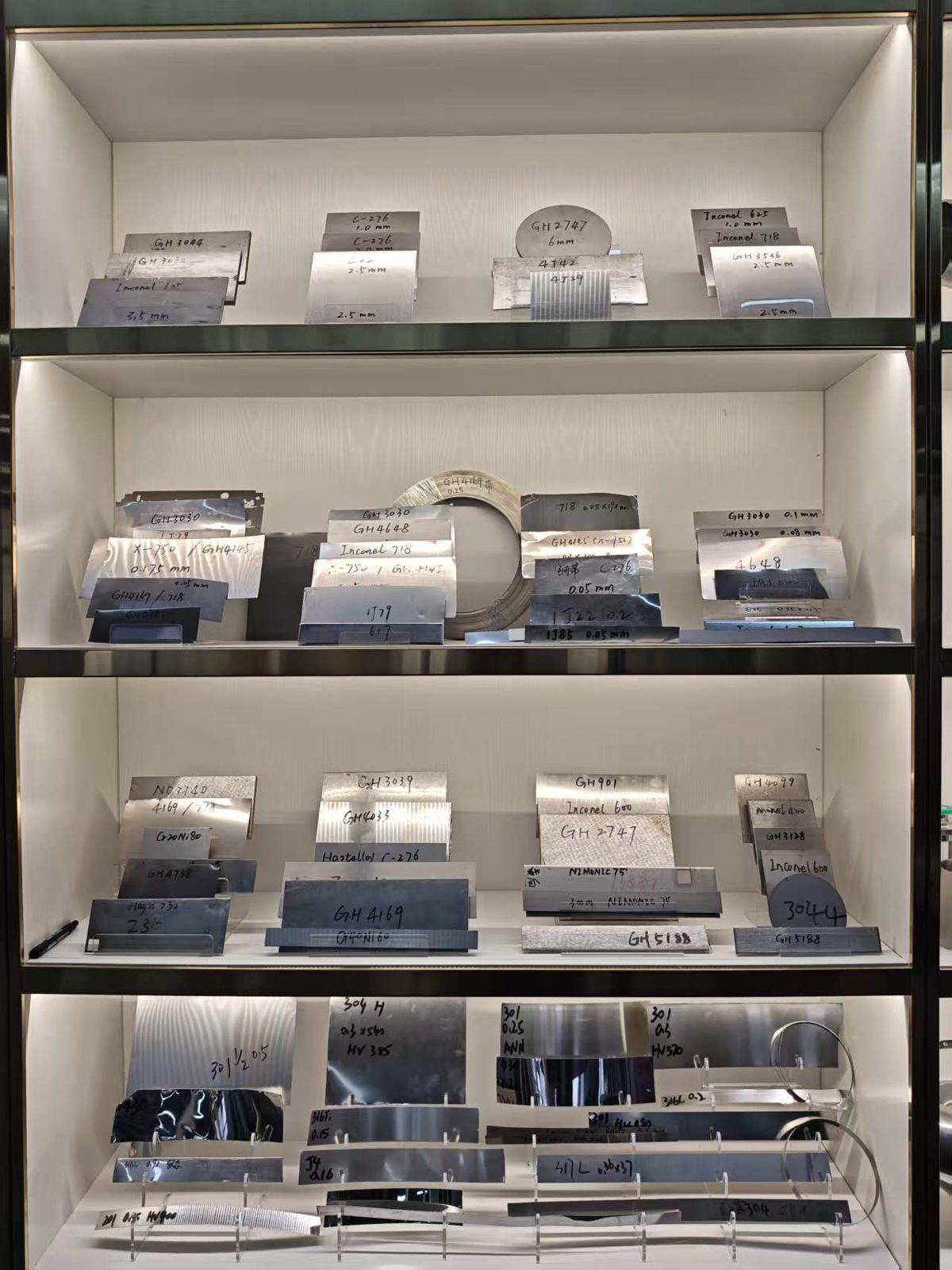
Rene 65 (AMS 5950) is a 4th-generation nickel-based superalloy developed by Allegheny Technologies Incorporated (ATI, formerly Allvac) for advanced high-pressure turbine disc applications in next-generation aero engines. The alloy was specifically engineered to bridge the temperature gap between Inconel 718 (the workhorse of turbine discs for decades) and the more expensive and difficult-to-process Waspaloy, Udimet 720, and Rene 88DT alloys. Rene 65 offers approximately 30°C higher temperature capability than Inconel 718 while maintaining good forgeability, weldability, and ultrasonic inspectability.
The defining metallurgical feature of Rene 65 is its high volume fraction of gamma-prime (γ′) phase, approximately 40% after full aging, achieved through a balanced addition of aluminum (2.1%) and titanium (3.5%). This places the alloy in a strength regime between Inconel 718 (~14% γ′) and Waspaloy (~50% γ′), but with significantly better low-cycle fatigue (LCF) life than 718 and much better processability than Waspaloy. The high Co (13%) and balanced Cr (16%) + Mo (4%) + W (4%) content provide solid-solution strengthening and adequate oxidation resistance for turbine disc service.
Rene 65 was designed from the outset to support modern engine demands: higher turbine inlet temperatures, lower fuel consumption, longer overhaul intervals, and improved reliability. Today, Rene 65 is in production for high-pressure turbine discs in several new-generation commercial and military aero engines, and is also being adopted for industrial gas turbine discs and rocket engine turbopump components. Hangbo Alloy Group supplies Rene 65 in forged bars, billets, rings, and HIP'd PM shapes per AMS 5950 and customer-specific aerospace specifications.
The chemistry of Rene 65 is carefully engineered to maximize gamma-prime strengthening while keeping the alloy forgeable, weldable, and ultrasonically inspectable. The high Co+Cr content provides solid-solution strength and oxidation resistance, while balanced Al+Ti additions give the desired gamma-prime volume fraction for elevated-temperature strength. Trace B and Zr additions strengthen grain boundaries for improved LCF life and creep ductility.
| Element | Min % | Max % |
|---|---|---|
| Nickel (Ni) | Balance | Balance |
| Chromium (Cr) | 15.0 | 17.0 |
| Cobalt (Co) | 12.0 | 14.0 |
| Molybdenum (Mo) | 3.5 | 4.5 |
| Tungsten (W) | 3.5 | 4.5 |
| Aluminum (Al) | 1.80 | 2.30 |
| Titanium (Ti) | 3.20 | 3.80 |
| Niobium (Nb) | 0.50 | 1.00 |
| Iron (Fe) | — | 1.50 |
| Manganese (Mn) | — | 0.10 |
| Carbon (C) | 0.005 | 0.020 |
| Boron (B) | 0.015 | 0.040 |
| Zirconium (Zr) | 0.015 | 0.040 |
| Phosphorus (P) | — | 0.010 |
| Sulfur (S) | — | 0.003 |
| Silicon (Si) | — | 0.10 |
| Oxygen (O) | — | 0.005 |
| Nitrogen (N) | — | 0.010 |
Rene 65 is fully austenitic (FCC) in all standard heat-treated conditions and is non-magnetic. Its physical properties are similar to other high-Co, high-Mo+W nickel superalloys in its class. The relatively high density (8.20 g/cm³) is a consequence of the high refractory metal content but is acceptable for rotating components where strength-to-weight is the primary design criterion.
| Property | Value | Unit |
|---|---|---|
| Density | 8.20 | g/cm³ |
| Solidus Temperature | 1280 | °C |
| Liquidus Temperature | 1340 | °C |
| Specific Heat (20°C) | 420 | J/kg·K |
| Thermal Conductivity (20°C) | 10.5 | W/m·K |
| Thermal Conductivity (700°C) | 22.0 | W/m·K |
| Electrical Resistivity (20°C) | 1.35 | μΩ·m |
| Modulus of Elasticity (20°C) | 210 | GPa |
| Modulus of Elasticity (700°C) | 175 | GPa |
| Mean CTE (20–200°C) | 12.0 | μm/m·°C |
| Mean CTE (20–700°C) | 14.2 | μm/m·°C |
| Magnetic Permeability | 1.001 | (non-magnetic) |
Rene 65 is supplied in the solution-treated and aged condition per AMS 5950. The standard heat treatment consists of a sub-solvus solution anneal at 1140–1170°C followed by a two-step aging sequence at 760°C / 8h and 650°C / 16h. The result is a fine-grained microstructure with uniform gamma-prime precipitation, providing the optimum balance of strength, fatigue life, and creep resistance for turbine disc service. The values below are representative for forged bar and HIP'd PM material.
| Property | S&A Value |
|---|---|
| Tensile Strength | 1620 MPa (235 ksi) |
| Yield Strength (0.2% offset) | 1240 MPa (180 ksi) |
| Elongation in 4D | 20% |
| Reduction of Area | 25% |
| Hardness | 42-46 HRC |
| Charpy V-notch Impact (RT) | 35 J min |
Rene 65 was designed to deliver outstanding tensile, creep, and fatigue performance in the 600–700°C temperature range typical of high-pressure turbine disc bores and webs. The combination of high gamma-prime volume fraction, balanced refractory metal solid-solution strengthening, and B+Zr grain-boundary strengthening gives the alloy a unique combination of properties for rotating components.
Unlike Inconel 718, which loses strength rapidly above 650°C, Rene 65 maintains high yield strength (above 1000 MPa) at 700°C, enabling the higher turbine operating temperatures demanded by modern high-bypass-ratio engines. This allows engine designers to either raise turbine inlet temperatures for higher efficiency, or to reduce cooling-air bleed for improved specific fuel consumption.
Rene 65 provides a balanced creep-rupture capability at 650–700°C that exceeds Inconel 718 by a factor of 3–5x at equivalent stress levels. While not as creep-resistant as Waspaloy or Udimet 720 above 720°C, the alloy is designed to provide a wide margin of safety across the operating envelope of typical HPT discs.
The defining design advantage of Rene 65 over Inconel 718 is its substantially better low-cycle fatigue life, which is the dominant failure mode for turbine discs subjected to repeated takeoff-cruise-land cycles. LCF tests at 600–700°C consistently show Rene 65 offering 5–10x longer life than 718 at equivalent strain ranges, supporting longer overhaul intervals and higher reliability.
| Temperature (°C) | Tensile Strength (MPa) | Yield Strength (MPa) | Elongation (%) |
|---|---|---|---|
| 20 (Room) | 1620 | 1240 | 20 |
| 538 | 1480 | 1130 | 18 |
| 650 | 1390 | 1080 | 18 |
| 700 | 1310 | 1020 | 20 |
| 750 | 1180 | 920 | 22 |
| 800 | 1010 | 800 | 25 |
Rene 65 is selected for the most demanding high-pressure rotating components in modern aero and industrial gas turbines. Its primary applications leverage the combination of high strength at 650–700°C, excellent low-cycle fatigue resistance, and good processability.
Hangbo Alloy Group supplies Rene 65 in the product forms required by modern aerospace and industrial turbine manufacturers. Material is melted by VIM (Vacuum Induction Melting) followed by ESR (Electroslag Remelting) and/or VAR (Vacuum Arc Remelting) to achieve the cleanliness levels required by AMS 5950. All material is supplied with full EN 10204 3.2 or aerospace-equivalent certification, ultrasonic inspection per ASTM E2375, and grain-size certification.
Rene 65 is significantly more difficult to weld than Inconel 718 due to its higher Al+Ti content and gamma-prime volume fraction, both of which make the alloy susceptible to strain-age cracking (SAC) in the heat-affected zone. Successful fabrication requires careful control of preheat, interpass temperature, and post-weld heat treatment.
| Standard | Description |
|---|---|
| AMS 5950 | Rene 65 Bars, Billets, and Forgings |
| AMS 7000-series | Powder for Additive Manufacturing |
| ASTM B637 | Precipitation-Hardening Nickel Alloy Bars, Billets, and Forgings (general) |
| ASTM E2375 | Ultrasonic Inspection of Nickel Alloy Forgings |
| AMS 2430 | Shot Peening |
| AMS 2433 | Foreign Object Damage (FOD) Prevention |
| ASTM E8 / E21 | Tensile Testing at Room and Elevated Temperature |
| ASTM E139 | Creep, Creep-Rupture, and Stress-Rupture Testing |
| ASTM E606 | Strain-Controlled Low-Cycle Fatigue Testing |
| Customer Specifications | OEM-specific aerospace material specifications (e.g., GE, Pratt & Whitney, Rolls-Royce, Safran) |
Shanghai Hangbo Alloy Group is a professional manufacturer and global supplier of Rene 65 (AMS 5950) for aerospace and industrial gas turbine applications. We provide forged bars, billets, rings, HIP'd PM shapes, and AM powder with full aerospace-equivalent certification, ultrasonic inspection, and customer-specific documentation. ISO 9001:2015 + AS9100D quality systems, fast delivery to global aerospace customers.
Rene 65 (AMS 5950) is a 4th-generation nickel-based superalloy developed by ATI for high-pressure turbine disc applications. It combines ~40% gamma-prime volume fraction with balanced Co+Cr+Mo+W chemistry, providing ~30°C higher temperature capability than Inconel 718 with excellent fatigue strength and processability.
Nominal composition: Ni balance, Cr 16.0%, Co 13.0%, Mo 4.0%, W 4.0%, Al 2.1%, Ti 3.5%, Nb 0.7%, Fe ≤1.0%, B 0.025%, Zr 0.025%, plus strict control of C, Mn, Si, S, P, O, and N. The high Al+Ti content drives the high gamma-prime volume fraction.
Rene 65 has a density of approximately 8.20 g/cm³ (0.296 lb/in³) and a solidus temperature of about 1280°C (2335°F).
Solution-treated and aged Rene 65: tensile strength ~1620 MPa (235 ksi), yield strength ~1240 MPa (180 ksi), elongation ~20%, hardness 42-46 HRC. The alloy retains yield strength above 1000 MPa at 700°C.
Rene 65 is covered by AMS 5950 (bars, billets, forgings), with additional reference to AMS 7000-series for AM powder and ASTM E2375 for ultrasonic inspection. The alloy is qualified under customer-specific aerospace specifications at major OEMs.
Rene 65 is designed for sustained service up to 700°C (1300°F) in turbine disc applications, roughly 30°C above Inconel 718. Short-term peak temperatures can reach 750°C in well-cooled sections.
Compared to Inconel 718, Rene 65 offers ~30°C higher temperature capability and 5-10x better LCF life. Compared to Waspaloy, Rene 65 has similar high-temperature strength but improved processability, lower risk of strain-age cracking, and better ultrasonic inspectability. Rene 65 sits between 718 and Waspaloy in both performance and cost.
Primary applications: high-pressure turbine (HPT) discs, low-pressure turbine (LPT) discs, compressor discs, shaft and drum components, afterburner parts, industrial gas turbine discs, rocket engine turbopump housings, and 4th/5th-generation military engine hot-section components.
Yes, but with more care than 718. Rene 65 should be welded in the solution-annealed condition using GTAW, plasma, laser, or electron beam processes with low heat input. Matching Rene 65 or ERNiCrMo-2 filler is recommended. A full re-solution + aging PWHT is required after welding to restore creep and fatigue properties.
Hangbo Alloy Group supplies Rene 65 in forged bars (50–500 mm), forged billets (up to 1200 mm), hot-rolled rings, HIP'd PM shapes, additive manufacturing powder, and custom closed-die forgings. All material is supplied with EN 10204 3.2 or aerospace-equivalent certification.
Yes, Rene 65 has been studied for laser powder bed fusion (LPBF) and electron beam melting (EBM) of aerospace hot-section components. The alloy requires careful HIP parameter control to close residual porosity and develop a fine-grained microstructure. Hangbo Alloy Group supplies plasma-atomized Rene 65 powder meeting AMS 7000-series powder specifications.
Rene 65 is a premium aerospace superalloy. Mill-direct pricing typically ranges from $120–220/kg for forged bars and $180–320/kg for finished turbine disc forgings, depending on size, quantity, and certification level. Lead times are typically 16–24 weeks for custom mill orders due to the multi-step VIM/ESR/VAR melting sequence and long forging cycles. MOQ is generally 200 kg for stock sizes and 500–2000 kg for custom orders.
Request a quotation for Rene 65 forged bars, billets, rings, or HIP'd PM shapes for aerospace or industrial gas turbine applications. We provide full AMS 5950 and customer-spec certification.